The Power of Emotional Intelligence

Ever get that gut feeling that something’s wrong, but you’re not sure exactly what you’re feeling, or why? Maybe your partner isn’t texting back, and it’s got you stressed that something has changed. Or you don’t like how that conversation went with your boss. Are you about to be fired, or were they just having an off day? Maybe you are dreading a conversation you’ll need to have with your mother this weekend (one you know she won’t take well, no matter how you approach it).
When you can’t shake that feeling, it can lead to a pretty sour day. You can’t enjoy your lunch because you’re too tense to appreciate it. You can’t focus at work, and all you want to do is reach for your vape, your phone, that junk food, or some other distraction. Regular traffic feels like an enormous inconvenience, almost a personal insult. And when you get home and have to face making dinner, answering a hundred questions, and you’ve just tripped over a pair of shoes in the wrong place? You might be ready to scream.
Days when you’re being haunted by a feeling but you’re not sure what it is, or what to do about it, are tough. But you don’t have to put up with these mysterious feelings that throw off your whole day. What can you do instead? Develop your emotional intelligence.
What is emotional intelligence?
Emotional intelligence (EQ) is a foundational concept to understanding both yourself and other people. It’s the ability to feel, name, and understand the emotions you’re experiencing, to figure out what they’re telling you, and then use that information to guide your thoughts and behaviors.
Understanding yourself helps you manage your feelings, instead of your feelings managing you.
Taking the time to better understand your emotions, how they come from thoughts, and how they inform your coping mechanisms, habits, and behaviors can help you change how much influence your emotions have over your everyday life. It can help you shake off feelings that aren’t serving you, and pay close attention to ones that are cluing you in to what you really want. People with high emotional intelligence experience less stress, lower incidences of anxiety and depression, and are much more likely to reach for healthy, constructive coping mechanisms when dealing with intense emotions.
Emotional intelligence is an interpersonal strength too
Research has shown that people with high emotional intelligence also understand the emotions of others well. They have an easier time in social situations, they have more rewarding relationships, and they are more able to be discerning about who they are close to. They are better in leadership, have better work outcomes, and are more able to understand and thoughtfully engage with the emotions of others.
Now that you better understand why emotional intelligence can help you, let’s take a look at how to develop it.
How can you develop more emotional intelligence?
Expand your self-understanding and self-acceptance through mindfulness
Mindfulness is a great way to expand your self-awareness and self-acceptance. Paying attention to your physical sensations, your thoughts, and what’s happening around you in the present moment, without judging or labeling your experiences, can help you develop your emotional intelligence.
Through meditation, you can look inward without judgment, assessing what you’re physically feeling, and what that tells you about your emotional state. That pit-of-the-stomach feeling? Probably fear. Hot face and chest, tense muscles, clenched jaw? Anger. You can also notice what thoughts are bringing on these sensations. “I’m going to get fired!” or “How could they do that to me? It had to have been on purpose!” can lead to some pretty intense emotions.

The non-judgmental part of meditation is particularly helpful. As you breathe and notice your body and mind, let thoughts and feelings come and go. Don’t try to label them as good or bad; they just are. Instead of feeling shame or frustration with yourself for having an emotion, which keeps that emotion around longer, meditating on your thoughts and feelings lets them happen, then move on.
With practice, you’ll be able to see what you’re feeling as information, and you won’t be pushed to react. You can choose your responses instead. Let’s look at the example of the dread you feel about a future conversation with your mother.
When you sit and meditate on that feeling, you might notice a sick-stomach feeling and the tension in your arms and neck that tells you you’re anxious, fearful, and ready for a fight. You can name those emotions in your head, and recognize you’re feeling this worry because old memories of tough conversations are bubbling to the surface. You can recognize that these memories are thoughts now, not experiences you’re in right this second, so you don’t have to pay close attention to them.
Right now, you feel worried, but you’re not on the phone yet. And as your worry eases, you might realize you need to prepare for this conversation. You might write down what you’ll say, or ask your sister to be there with you during the conversation. Instead of derailing your day, feeling awful, you’ve sat with your feelings, named them, and then found ways to support yourself through a difficult experience. And every time that worry pops up again, you can start over, sitting with the feelings, naming them, and letting them go.
Check the facts to help you focus your attention

Thoughts that pop into our heads can sometimes be recognition of facts, but often include some assumptions along with them. From there, they can trigger emotions, which can trigger behaviors, leading to a cascade all based on assumptions, not facts.
As part of your mindful approach to EQ, when you’re feeling a strong emotion, check the facts of the situation. You might even consider writing them out in a list so you can see things clearly. “I am feeling anxious” is a fact. “I haven’t heard from my partner in two hours” is a fact. “So they must be cheating on me” is an assumption, and one that could lead to some pretty strong feelings! When you check the facts, you help recognize when feelings are based on assumptions, and you can more easily let those thoughts and feelings go, instead of using them to make decisions.
Use the feelings wheel to understand the root of your emotions
Many of us struggle to name the deeper, hidden emotions at the root of our intense feelings
The feelings wheel, developed by Dr. Gloria Wilcox in the 1980s, is a great tool to try to correlate an emotion, such as fear, back to more hidden, complex feelings and unmet needs. It combines color and words to help you trace. Try out the feeling wheel next time you’re feeling an intense emotion, and see where it takes you.
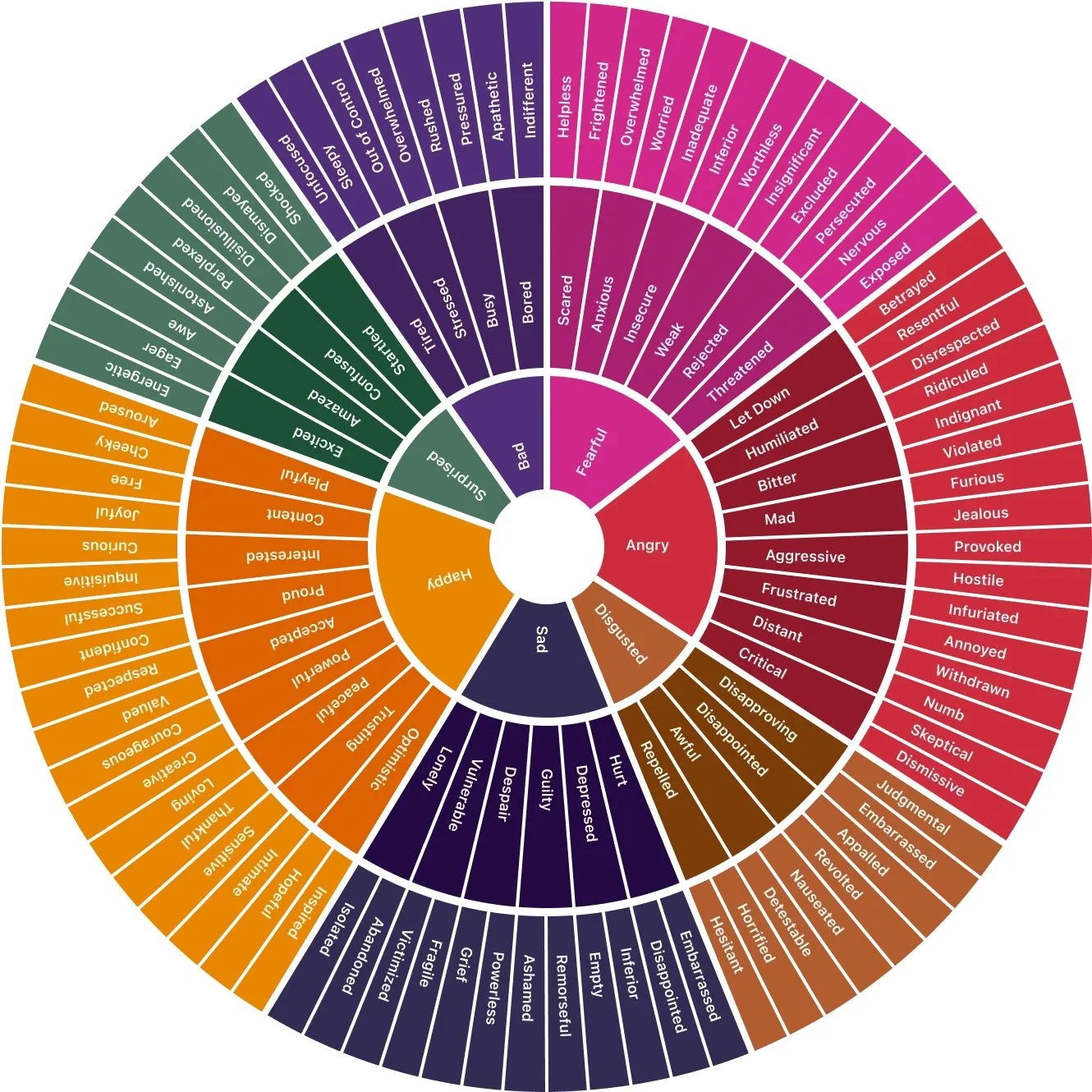
For example, “fear” is a very broad concept, and you can use the feelings wheel to trace what you’re feeling from “fear” to “insecure” to “inadequate”. This can help you understand what you’re going through when you’re worried about your boss’s mood. You’re worried about being inadequate at work based on your boss’s behavior, and that thought is bringing up fear. This level of self-understanding can help you choose your next move, whether it’s to reassure yourself you’re very good at what you do, or to brush up on work skills, or to simply let the feeling pass you by, since the thought that brought it about was mostly assumptions.
Develop self-regulation
Self-regulation isn’t about being free of emotions, and it’s not about ignoring them. It’s recognizing you’re feeling an intense feeling, and taking a moment to experience it, name it, and then choosing what to do next.
Instead of tripping over a shoe and screaming after a long day, a self-regulated response would be tripping, recognizing you’re overwhelmed with anger, stopping everything, and taking a breath. You might count down from ten, or excuse yourself and go to another room until you’re less overwhelmed. You might even try something silly, like singing about how obnoxious stray shoes are at the top of your lungs (this is a great way to release emotional energy while keeping things light-hearted for people around you).
Self-regulation takes practice. You can start with small emotional moments, like annoyance at traffic. Mentally stop yourself, feel in your body where your annoyance is showing up, then name the feeling, out loud or in your head, e.g., “I am annoyed.” Next, choose what you want to do. Do you want to put on some music? Do you want to daydream about a vacation you are going to take?
Some self-regulation activities to try include:
Slowly breathe in, then exhale as long as you can.
Count backwards from a weird number, like 57 or 23.
Sing out loud about your frustrations.
Close your eyes and envision a calm place.
Take a moment and talk to yourself like you would a friend, with kindness and love.
Acknowledge your emotion and recognize that it makes sense to feel that way. Ask yourself what you’d like to do next.
Stop, stay still, and think about what you’re going to do next, in detail.
EQ expands your understanding of emotions in others
As you start to understand your own emotional signals, you can start to notice them in other people, expanding your ability to empathize.
You might be frustrated that your mother is often cranky and talks about being bored, but doesn’t do anything to make her life more interesting. As you expand your emotional intelligence, you’ll be able to feel your frustration, then let it go. You can think further about her feelings since yours aren’t taking up all your attention, and you might realize she used to do everything with your father, but since he passed away, she hasn’t been able to learn how to get out and do things on her own. Instead of dreading phone calls full of guilt, you might strategize with your siblings to figure out ways to get her out of the house, using empathy to reduce your stress and improve your mother’s life at the same time.
You might also realize that when your boss was a little off in your conversation, it wasn’t because of you; it seemed more like sadness, since you also get quieter when you’re feeling sad. This gives you more context for your boss and helps make the moment less about you. People live complex lives and have complex reasons for their emotional expressions, and emotional intelligence can make it easier to see that you’re not always a factor in how other people express emotions around you. This lightens your emotional workload and helps you feel less responsible for the feelings of everyone around you.
Therapy in Coral Springs, FL, can offer reflection and feedback to better develop your emotional intelligence

You don’t need to try to develop emotional intelligence all on your own. While reflection, meditation, and insights about yourself are crucial to developing emotional intelligence, we can deepen our EQ through reflection and feedback from others as well.
Having the help of an empathetic therapist who creates a safe space for you to work on your emotional intelligence can help you go further in your journey to self-regulation and self-understanding. Alexa at Haven Family Therapy can provide helpful reflection and feedback as you process your feelings.
Alexa provides therapy for teens and adults looking to develop their emotional intelligence in Coral Springs and Fort Lauderdale, offering sessions in both English and Portuguese. Call Alexa today at 786-565-2465 or schedule a free 15-minute consultation to get started.